Is the input voltage of a solar panel related to the intensity of sunlight? Does a higher voltage mean more electricity generation?

Many users new to photovoltaic systems have similar questions! The input voltage of a solar panel is indeed related to light intensity, but it’s not true that “the stronger the light, the higher the voltage will rise indefinitely”; and the idea that “higher voltage means more power generation” is a common misconception. The core factor determining power generation is power output.
- Relationship between Solar Panel Input Voltage and Light Intensity
The input voltage of a solar panel is mainly divided into two categories: “open-circuit voltage” (the voltage when no load is connected) and “operating voltage” (the actual voltage when connected to a load and generating power normally). The relationship between these two voltages and light intensity is not the same.
The open-circuit voltage will slightly increase with increasing light intensity, but the increase has a clear upper limit. For example, with a common monocrystalline silicon solar panel, when the light intensity increases from 200W/㎡ (low light environment) to 1000W/㎡ (close to standard test conditions, similar to midday sunlight on a sunny day), the open-circuit voltage may slowly increase from 35V to around 38V (the specific value varies slightly depending on the solar panel brand and model); however, once the light intensity exceeds 1000W/㎡, the open-circuit voltage will gradually stabilize and will not increase significantly with further increases in light intensity.
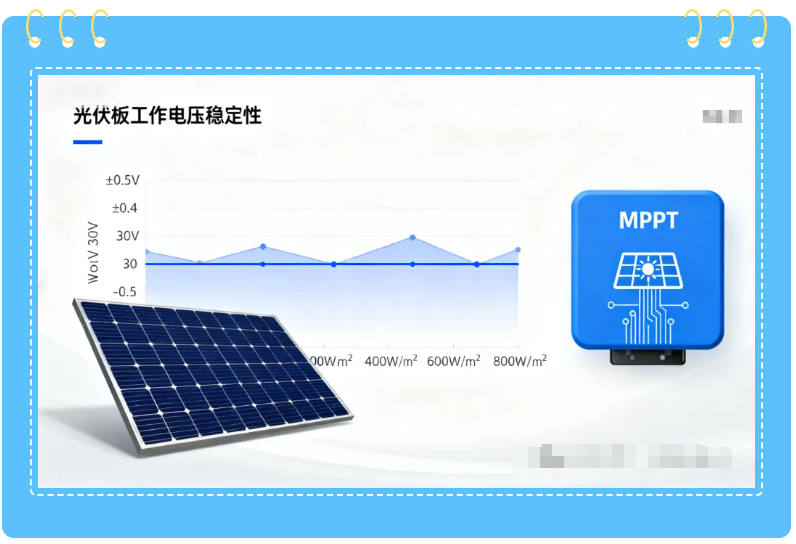
The operating voltage remains relatively stable within the “effective illumination range.” During normal power generation, the photovoltaic system uses an MPPT (Maximum Power Point Tracking) controller to precisely stabilize the operating voltage near the “maximum power point voltage (Vmp)” – as long as the light intensity is not lower than the starting threshold (generally 50-100 W/m², equivalent to weak light conditions on a cloudy day or in the evening), the operating voltage will not fluctuate significantly with changes in light intensity. For example, for a 250W solar panel, its Vmp is usually fixed at around 30V. Even if the light intensity increases from 300 W/m² to 800 W/m², the operating voltage fluctuation will be controlled within ±0.5V, which will not affect normal power generation.
It is crucial to note that temperature has a more direct and significant impact on the voltage of solar panels than light intensity. Even if the light intensity remains completely unchanged, as long as the ambient temperature rises, both the open-circuit voltage and the operating voltage of the solar panel will decrease. The temperature coefficient is usually -0.3%/℃ to -0.5%/℃ – simply put, for every 1℃ increase in ambient temperature, the solar panel voltage decreases by approximately 0.3% to 0.5%. For example, an operating voltage of 30V at 30℃ might drop to 29.1V to 28.5V at 40℃. This is especially important to consider in high-temperature environments during the summer.
- The Relationship Between Voltage and Power Generation: Higher Voltage Isn’t Always Better
To determine the power output of a solar panel, the key factor is “power (P)” – the formula for power is “voltage (V) × current (I)”. This means that power generation is determined by both voltage and current; simply looking at the voltage alone is insufficient to determine power output. A comprehensive analysis considering both voltage and current is necessary.
Only when the “current remains constant” will an increase in voltage lead to an increase in power, and thus increased power generation. For example, if two identical 30V solar panels are connected in series (total voltage becomes 60V), and the circuit current remains constant at 8A (provided that the series connection does not exceed the load capacity of the inverter and controller), then the total power will increase from 240W (30V × 8A) to 480W (60V × 8A). In this case, the “increase in voltage” directly leads to an increase in power generation.
However, if the voltage increases while the current decreases significantly, the power generation will actually decrease. The most typical situation is “excessive load resistance”: for example, a solar panel that originally outputs 8A of current at 30V (240W power) might see its voltage increase to 40V if the load resistance suddenly increases, but the current will drop sharply to 5A (because the excessive resistance limits the current flow). In this case, the total power will decrease from 240W to 200W, resulting in lower power generation than before.
The key is that each solar panel has a “maximum power point,” and the voltage (Vmp) and current (Imp) at this point are the optimal combination determined by the manufacturer’s design. Only by operating the solar panel at this point can maximum power generation be achieved. Whether intentionally increasing or arbitrarily decreasing the voltage, it will cause the solar panel to deviate from the “maximum power point,” ultimately leading to a decrease in power generation.